Senate math tightens as races move left
Democrats need four net flips to take control, but competitive races now extend into deep red states that were long considered safe.
By Pablo Serrano ·
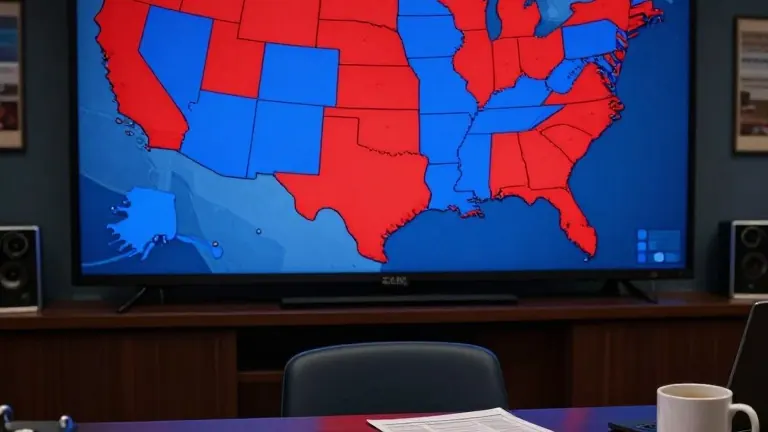
The path for Democrats to seize control of the U.S. Senate has narrowed in the final days of the 2026 midterm cycle. At the start of the year, the party faced a steep uphill battle because most open seats were in states President Trump won by double digits in 2024. Now, polling and advertising data show the field widening considerably, with multiple races in traditionally red states hovering within the margin of error.
According to the Cook Political Report, Alaska, Iowa, Kansas, Ohio, and Texas are all classified as toss-ups. These states were not expected to be competitive early in the cycle. The shift has altered the strategic calculus for both parties as they finalize their final push for voters.
Kirsten Gillibrand, chairwoman of the Democratic Senatorial Campaign Committee, described the current environment as energizing. She noted that candidates are winning in deep red and purple locations. Gillibrand stated that people want change and that the party has significant talent on the field. Her comments reflect the party's optimism despite the historical difficulty of winning in these regions.
Republicans maintain a more skeptical view of the shifting tides. Bernadette Breslin, national press secretary for the National Republican Senatorial Committee, characterized the Democratic surge as reaching a fever pitch. She cited a controversy in the Alaska race regarding the recruitment of Democrat Mary Peltola. Breslin argued that common-sense voters in red-leaning battlegrounds are preparing to reject the party's agenda.
North Carolina stands out as a primary target for Democrats. The state was seen as a toss-up at the beginning of the cycle, but it is now rated as a likely Democratic flip. Former Governor Roy Cooper is the front-runner, a status even President Trump acknowledged during a recent visit. Trump said Cooper was going to become the state's senator, calling the outcome crazy.
Georgia, once a top Republican target, is now viewed as a likely hold for Democrats. This shift leaves Republicans with fewer clear paths to offset Democratic gains. Key Republican targets remain in Michigan, New Hampshire, and Minnesota. Winning any of these seats would complicate the mathematical requirements for Democrats to reach the necessary net gain of four seats.
The final outcome depends heavily on Republican turnout. Low participation among GOP voters could determine whether Democrats net one or two seats or pick up six or seven. In Texas, Democrat James Talarico has led in almost every poll, a stark contrast to 2018 when Beto O'Rourke never led. In Iowa, tariffs and rising diesel prices have hurt the agricultural economy, putting Republicans on the defensive against Democrat Josh Turek.
In Ohio, challenger Sherrod Brown is leveraging his name recognition despite being out of office since 2024. Republicans have treated him as an incumbent in their strategy. In Alaska, the late recruiting scandal threatens to derail momentum for Peltola. The Cook Report places these races in the middle tiers of competitiveness, alongside Maine and Kansas, where incumbents face tough challenges from well-funded challengers.
Source: WCBE