Long Island Museum lets visitors step inside an 1887 streetcar
The new permanent exhibit uses a historic vehicle to tell the story of Elizabeth Jennings, a teacher who challenged segregated transit in 1854.
By Marcus Reed ·
Visitors can now climb aboard a historic horse-drawn vehicle at the Long Island Museum.
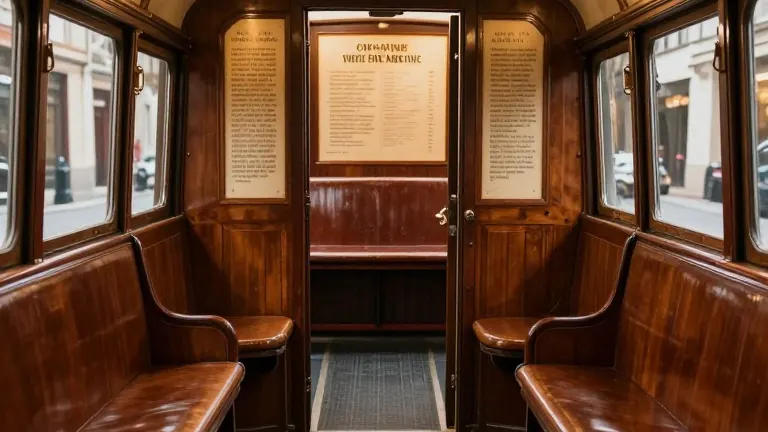
The museum in Stony Brook opened a new permanent exhibition in the Carriage Museum on October 15. The piece, titled Riding Towards Justice, allows guests of all ages and abilities to stand inside an 1887 streetcar. This design choice aims to make the history of public transportation more tangible and accessible for a wide audience.
The central vehicle is a 24-foot-long streetcar built in 1887 by the J. G. Brill Company of Philadelphia. It has a notable history beyond transportation. The car was retired from service, held in a private collection, and later repainted to look like a New York City streetcar for the 1969 film Hello, Dolly. Barbra Streisand starred in that movie. The museum received the vehicle as a donation in 2019.
Sarah Abruzzi, Co-Executive Director of Operations at the museum, said the project responds to direct feedback from visitors. She noted that guests often asked for a chance to climb into the vehicles on display. "Our visitors have given us feedback that they wanted an opportunity to climb into a vehicle, and we are so pleased that this project has made that possible," Abruzzi said. The museum describes itself as home to the nation's most important collection of horse-drawn carriages.
The development of the exhibit took two years. It was funded in part by a grant from the Institute of Museum and Library Services. Southside Design & Building of Brooklyn handled the construction work. Thirty-three community members also contributed funds to help bring the project to completion. A ribbon-cutting ceremony on October 15 included a special proclamation from Councilmember Jonathan Kornreich. He declared the day "Riding Towards Justice Day" for the Town of Brookhaven.
The exhibition focuses on the fight for equal rights in horse-drawn public transportation. It specifically examines the life of Elizabeth Jennings, a Black school teacher who lived from 1827 to 1901. In 1854, Jennings fought for her right to ride a New York City streetcar. This action occurred nearly 100 years before the more famous 1955 protest by Rosa Parks in Alabama. The museum uses text panels and a video portrayal of court testimony to explain how Jennings's case helped change regional transit systems.
Nina Sangimino, the museum's curator, emphasized the educational value of the physical experience. "Through this powerful interactive exhibition, visitors are able to gain insight into Elizabeth's important story, and how she helped catalyze change through determination, bravery, and defiance," Sangimino said. She added that sitting aboard the actual streetcar helps history come alive for children and adults alike.
Accessibility was a primary focus during the renovation. The installation features a fully wheelchair-accessible ramp that allows visitors to board the streetcar easily. Designers added LED lighting and made small interior modifications to ensure the space is usable for everyone. Large projected videos show early 20th-century New York City traffic scenes. There is also a smell-based interactive element that invites visitors to experience the odors of late-19th-century city streets.
A team of consultants helped guide the project. Advisors included Mia Bay, a professor of American History at the University of Cambridge, and Richard Bell, a history professor at the University of Maryland. Other advisors included Lynda Day from Brooklyn College, Janice Majewski from the Institute for Human Centered Design, Katherine Perrotta from Mercer University, and Rebecca Shulman from Museum Questions Consulting.
The Long Island Museum is located at 1200 Route 25A in Stony Brook. It is open Thursday from 11:30 a.m. to 7 p.m., with free admission after 5 p.m. On Friday, Saturday, and Sunday, hours are from noon to 5 p.m. Admission costs $15 for adults, $10 for seniors and students, and is free for children ages 6 and under. The Carriage Museum houses more than 100 historic vehicles and over 800 carriage-related artifacts.
Source: TBR News Media